FUSION Free-Cooling Chiller
FUSION combines free cooling, a microchannel condenser and inverter EC fans across 15–2,000 kW, with potential energy savings of up to 60%.
Inside the series
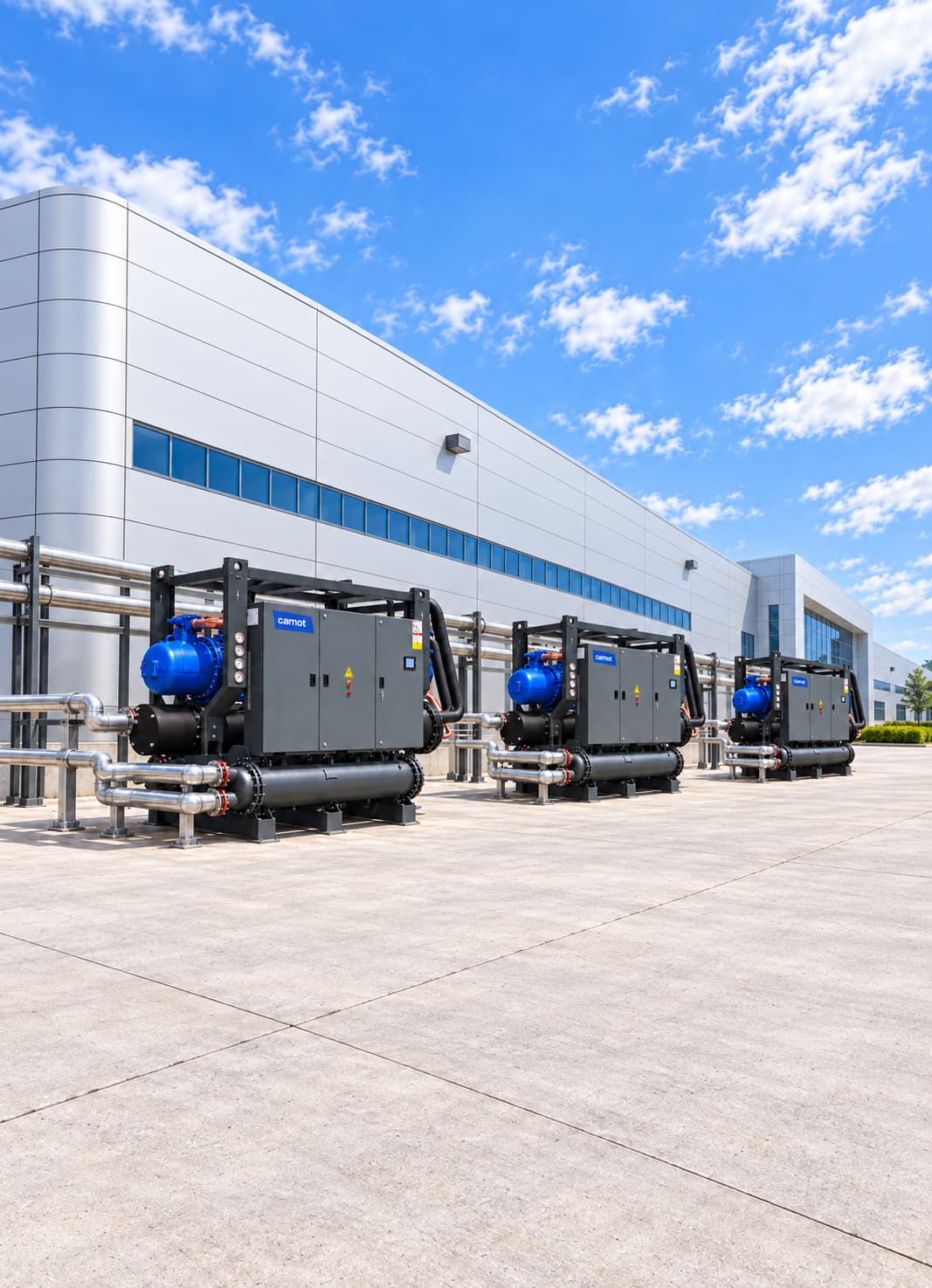
The FUSION Series is a high-efficiency air-cooled free-cooling chiller family that uses low ambient temperatures to reduce compressor operation. Available from 15 to 2,000 kW, it is developed for industrial processes, data centres and facilities where energy consumption is critical and cooling is required throughout the year.
The FUSION Series continuously monitors ambient temperature and process-water temperature, automatically switching between mechanical cooling, hybrid free cooling and full free cooling. When outdoor conditions are suitable, compressor capacity is reduced or the compressors are stopped completely so that cooling energy is obtained directly from outdoor air.
The microchannel condenser technology used in the units combines high heat-transfer performance with a compact structure. Inverter-controlled EC fans fitted as standard continuously adjust their speed to the required airflow, reducing fan energy consumption and noise.
The free-cooling coil, condenser, compressors, fans and control system are managed through a single automation infrastructure. The system therefore automatically determines the operating mode that delivers the lowest energy consumption as ambient temperature changes.
The FUSION Series is designed to reduce not only instantaneous energy consumption but also the plant’s total annual cooling cost. In facilities with low process-water return temperatures and year-round operation, free-cooling hours increase and the investment payback period becomes shorter.
Three-Stage Operating System — Mechanical Cooling Mode
When the ambient temperature is not suitable for free cooling, cooling capacity is provided by the compressors. Inverter-controlled EC fans adjust their speed according to condenser pressure to prevent unnecessary energy consumption.
Hybrid Free Cooling Mode
As ambient temperature falls, the free-cooling coil pre-cools part of the process water. The compressors provide only the remaining cooling load, reducing compressor energy consumption while maintaining the target water temperature.
Full Free Cooling Mode
When ambient temperature is sufficiently low, the required cooling capacity is supplied entirely by outdoor air. The compressors stop and only the fans, pumps and control equipment continue to operate. This is the operating condition in which the highest energy saving is achieved.
Energy efficiency
FUSION energy savings comparison
Approved example scenario for a 1,000 kW cooling load operating 4,000 hours per year.
Scenario details
| Operating system | Electrical power | Annual operation | Annual consumption |
|---|---|---|---|
| Standard mechanical chiller (COP 4.5) | 222 kW | 4,000 hours | 888,000 kWh |
| FUSION mechanical operation | 222 kW | 1,600 hours | 355,000 kWh |
| FUSION hybrid free cooling | 125 kW | 1,000 hours | 125,000 kWh |
| FUSION full free cooling | 35 kW | 1,400 hours | 49,000 kWh |
| FUSION total | — | 4,000 hours | 529,000 kWh |
- Lower energy consumption
- 40%
- Annual energy saving
- 359,000 kWh
- Annual cost advantage
- ≈ €43,000
The instantaneous energy advantage in full free-cooling mode is approximately 84%. Actual savings vary with climate, process-water temperature, coil selection and plant load profile.
Technology and operation
Automatic changeover
Outdoor temperature determines the appropriate cooling mode.
Load-based fan speed
EC fans adapt airflow to the current cooling demand.
Compact heat exchanger
Microchannel construction supports effective heat transfer within a compact footprint.
FUSION
Technical specifications
- Capacity
- 15–2,000 kW
- Operating principle
- Free cooling
- Heat exchanger
- Microchannel
- Fan technology
- EC
- Control
- Automatic mode changeover
Capacity and operating temperatures are selected for your process load and site conditions.
Frequently asked questions
Answers to common technical questions about selection, application and operation.
Let's engineer solutions tailored to your needs
By analyzing your process and operational data against engineering criteria, we determine capacity, system configuration, and implementation details. Let's turn your technical requirements into the right equipment selection and an actionable system design.