
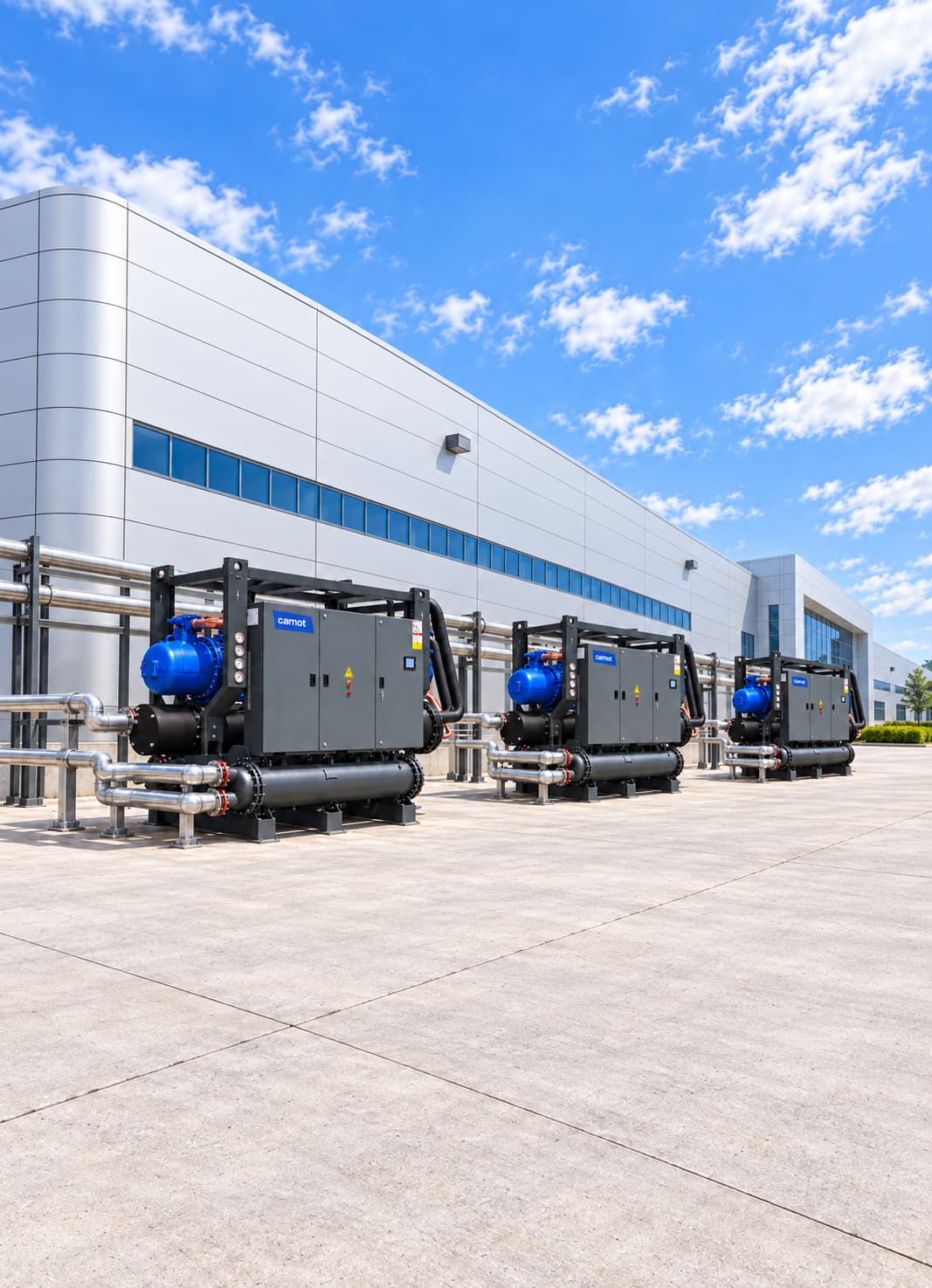

Industrial Refrigeration Systems for Cold Storage and Logistics Facilities
A cold storage refrigeration system combines a chiller, glycol circuit, evaporators and controls to handle incoming product loads, door infiltration and heat gain through the building envelope while maintaining room temperatures between −25 °C and +15 °C. Carnot designs each system around the facility’s heat-load calculation, redundancy plan and temperature-recording needs.
Sector Overview & Process Demands
A cold storage refrigeration system combines a chiller, glycol circuit, evaporators and controls to handle incoming product loads, door infiltration and heat gain through the building envelope while maintaining room temperatures between −25 °C and +15 °C. Carnot designs each system around the facility’s heat-load calculation, redundancy plan and temperature-recording needs.
Temperature control in cold storage and logistics facilities directly affects product quality, shelf life and cold-chain continuity. The system must maintain room temperature, bring incoming products to their target temperature on time, handle heat and moisture from door traffic and distribute air evenly across stored goods.
Carnot develops central and zone-based refrigeration systems for cold stores, frozen-food facilities, distribution centres and temperature-controlled logistics. Chillers, dry coolers, free cooling, pump and tank groups, heat exchangers and controls are engineered with reference to ASHRAE Refrigeration Handbook load-calculation methods and the EN 378 refrigerant safety standard, aiming to protect product temperature, reduce energy use and provide redundancy for critical loads.
Critical Operational Requirements
Why Is Cold Storage Refrigeration Critical?
A cold store must do more than maintain room-air temperature. The total load also depends on incoming product temperature, door openings, people and forklifts, lighting, evaporator fans and heat passing through the building envelope. A properly engineered refrigeration system addresses all these loads.
- Protects products in target temperature range.
- Provides monitoring of product core temperature.
- Meets load changes during door traffic.
- Balances temperature distribution in the warehouse.
- Manages the formation of moisture and freezing.
- Limits temperature swings caused by defrost.
- Maintains cooling in critical storage rooms.
- Allows measuring and improving energy consumption.
- It records the temperature history in the cold chain.
Which Cold Storage Applications Are Served?
Each product group has its own storage temperature, humidity requirement, allowable temperature variation and cooling time. HACCP requirements for food stores and Good Distribution Practice (GDP) requirements for pharmaceutical and medical stores affect temperature limits and record keeping. Design the system around the products and the operation.
- Carnot refrigeration systems are used in cold storage and logistics applications:
- Cold storage rooms
- frozen product stores
- Food distribution centers
- Meat, poultry and fish stores
- Milk and dairy-product stores
- Fruit and vegetable stores
- Ice cream stores
- Blast-chilling and pre-cooling lines
- Pharmaceuticals and medical product stores
- Temperature controlled logistic centers
- Cross-dock operations
- Loading and shipment areas
- Order preparation rooms
- Automatic storage systems
- secondary cooling circuits with glycol
- Facilities with process and warehouse cooling
System Design & Capacity Calculation
Engineering & Sizing Criteria
How Is a Cold Storage Refrigeration System Designed?
Cooling capacity cannot be determined from store volume or floor area alone. Two stores of the same size can have very different loads because of incoming product temperature, door traffic and daily product movement.
| Design Parameter | Engineering Significance |
|---|---|
Warehouse volume and surface area | Determines the transmission load passing through the structure. |
Panel thickness and U value | Determines heat gain through walls, roof and floor. |
External environment conditions | It determines the risk of highest summer load and condensation. |
Room Temperature | Affects compressor conditions and energy consumption. |
Product input temperature | Directly affects product cooling load. |
Daily product quantity | Determines product pull-down load. |
Door opening frequency | Determines humidity load with air infiltration. |
Personnel and vehicle traffic | Increases internal heat loads and door usage. |
Lighting and fans | It creates electrical heat load inside the warehouse. |
Defrost method | It affects energy consumption and room temperature fluctuation. |
Required operating continuity | Determines standby capacity and emergency response. |
Product placement | It affects air distribution and temperature stability. |
Capacity Calculation & Thermodynamic Formula
How Is Cold Storage Heat Load Calculated?
The total refrigeration load is made up of separate components. Calculate each of the following loads:
Additional loads considered in the calculation:
- Heat passing through structure
- Heat passing through wall, ceiling and floor:
- Here:
- **U:** Total heat pass coefficient of panel or structure element
- **A:** Area of the heat-transfer surface
- **ΔT:** Temperature difference between outdoors and the store
- Product cooling load
- To cool the target temperature from the inlet temperature of the product:
- air infiltration
- Internal loads
- Evaporator fans
- Lighting
- Staff
- Forklift and transport equipment
- Automation and conveyor systems
- Defrost energy
- Electric equipment in the room
Q = U × A × ΔT
Worked Engineering Example
Also assess thermal bridges at panel joints, doors, floors and structural members. Product load is Q = m × cp × ΔT. If the product freezes, add latent heat for phase change (334 kJ/kg for water) and the further sensible load to reach storage temperature. Warm, humid air entering through doors adds both sensible and moisture load: Q = ṁ × (h_outside − h_inside). Door size, open time and frequency, wind and vehicle traffic determine infiltration. Fans, lighting, people, forklifts, conveyors, defrost and other electrical equipment also become cooling loads. Size total capacity for the likelihood and duration of loads occurring together.
Secondary glycol circuits keep hazardous refrigerants in the plant room and help prevent product contamination.
Energy Optimization
Request an annual energy and free-cooling comparison for your facility.
Energy Consumption & Annual Operating Cost Analysis
800 kW Cold Storage & Logistics Center Annual Energy Simulation
Theoretical comparison for an 800 kW cold storage logistics facility operating 7,000 hours/year at secondary glycol conditions.
Scenario comparison table
| System | COP | Compressor power | Annual consumption |
|---|---|---|---|
| Reference chiller system | 2.80 | 285.7 kW | 1,999,900 kWh |
| High-efficiency Carnot system | 3.50 | 228.6 kW | 1,600,200 kWh |
| Theoretical saving / difference | — | 57.1 kW | 399,700 kWh (20.0%) |
| Annual cost advantage | — | €0.12/kWh | Approximately €48,000 |
Annual Electricity Savings
399,700 kWh
20.0% theoretical reduction in compressor use
Annual Cost Advantage
~48,000 €
Calculated at €0.12/kWh reference electricity rate
Theoretical Power Difference
57.1 kW
Reference COP 2.80 / Carnot COP 3.50
Note: This calculation compares compressor power at 7,000 hours of full load. Actual annual savings will depend on plant load profiles, process temperatures, pump and fan modulation, local weather data, and economizer hours.
Engineering & Sizing Checklist
Let’s Design Your Cold Storage System
Carnot designs the full system for your project, from store and product-load calculations to chiller, dry cooler, exchanger and pump selection, glycol-circuit design, temperature monitoring and annual energy analysis. The information below is enough for an initial review:
- 1Product type to be stored
- 2Number of rooms and sizes
- 3Target room temperatures
- 4Product input and target temperature
- 5Daily product intake and dispatch quantities
- 6desired cooling or freezing time
- 7Panel thickness and structure features
- 8Door dimensions, count and daily opening frequency
- 9Facility location
- 10Daily and annual working time
- 11Current cooling system information
- 12Requested backup level
- 13HACCP / GDP record-keeping requirements
- 14The planned capacity increase in the future
Request Cold Storage Refrigeration Design
Share your facility specs, and our engineering team will prepare your energy and capacity simulation.
Related products
Thule Series Air-Cooled Chiller
Offers application-specific low-temperature cooling for central water-glycol loops.
- Capacity
- 2–2,000 kW
- Compressor
- Scroll / screw
Tundra Series Water-Cooled Chiller
Suited to high-capacity central storage facilities with long operating hours.
- Capacity
- 30–4,000 kW
- Compressor
- Scroll / screw
ZERO Series Chiller
A low-GWP option that keeps the refrigerant charge in the plant room.
- Capacity
- 10–1,800 kW
- Refrigerant
- R1234ze
Fusion Series Free Cooling Unit
Pre-cools the glycol loop when outdoor temperatures permit.
- Capacity
- 15–2,000 kW
- Operating principle
- Free cooling
Kalter Series Dry Cooler
Rejects heat from storage and auxiliary process circuits to outdoor air.
- Capacity
- 90–1,800 kW
- System
- Dry cooler
Technical Questions About Cold Storage & Logistics Cooling Systems
Detailed engineering answers on system sizing, capacity calculations, water temperatures, and Carnot equipment.
Let's engineer solutions tailored to your needs
By analyzing your process and operational data against engineering criteria, we determine capacity, system configuration, and implementation details. Let's turn your technical requirements into the right equipment selection and an actionable system design.