
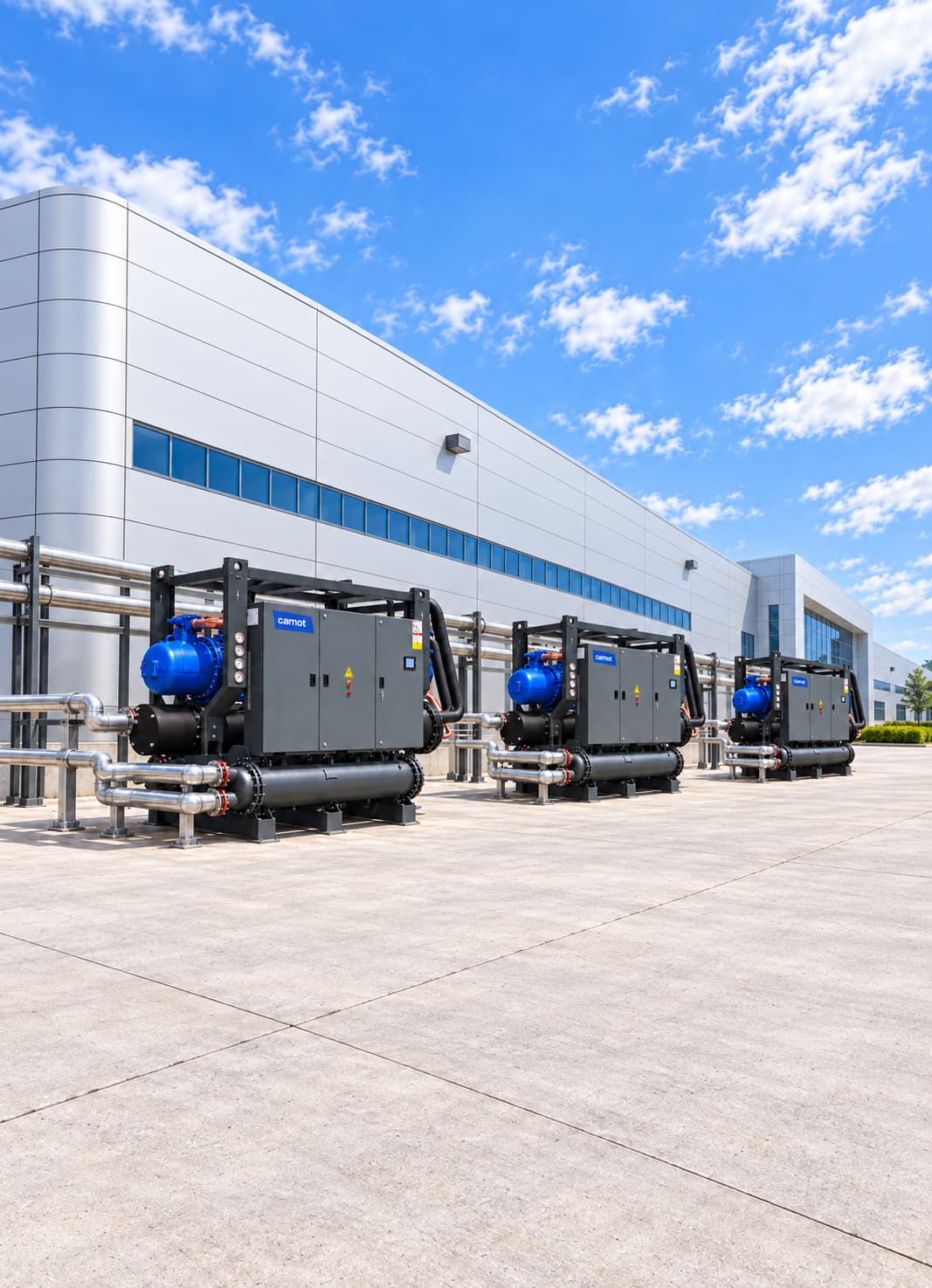

KALTER Industrial Dry Cooler
KALTER provides 90–1,800 kW industrial dry-cooler solutions with inverter fans, low energy consumption and no continuous water loss.
Inside the series
The KALTER Series is a high-efficiency dry-cooling system that removes the thermal load generated by industrial processes from water or a water-glycol mixture circulating in a closed circuit and transfers it directly to outdoor air. Available from 90 to 1,800 kW, the series is configured specifically for process cooling, hydraulic-oil cooling, chiller condenser-water cooling and free-cooling applications.
The fluid to be cooled passes through the large-surface-area finned-tube heat-exchanger coil inside the KALTER unit. While the fluid circulates through the tubes in a closed circuit, controlled airflow produced by the fans passes across the finned surfaces. Thermal energy moves first from the fluid to the tube surface, then to the fins and finally to outdoor air. Because the process fluid and outdoor air do not mix, system water remains clean and protected within the closed circuit.
Inverter-controlled fans used on every KALTER unit continuously adjust their speed according to ambient temperature, fluid inlet and outlet temperatures and the process’s instantaneous heat load. Reducing fan speed at low ambient temperature or partial load lowers unnecessary electricity consumption and noise. When heat load or ambient temperature rises, fan speed increases in a controlled manner to maintain the target fluid temperature.
The KALTER Series has no compressor-based refrigeration cycle. Its electricity consumption comes mainly from inverter fans and the system circulation pump. It can therefore deliver significant energy savings compared with mechanical chiller systems where process temperatures and ambient conditions are suitable.
The dry-cooling principle eliminates continuous water losses caused by evaporation, drift and blowdown in open cooling towers. Preventing contact between the process circuit and outdoor air reduces the entry of dust, sediment and foreign matter, helping protect heat exchangers, pumps and process equipment. Closed-circuit dry cooling provides a major advantage, especially at facilities with limited water resources.
KALTER capacity is determined by considering fluid type, inlet and outlet temperatures, flow rate, glycol concentration, ambient design temperature and heat-exchanger approach temperature. Heat-exchanger surface area, tube arrangement, fin spacing, fan count and controls are optimised for project conditions. This combines high heat-transfer capacity, low fan consumption, stable fluid temperature and low operating cost within one system.
Energy efficiency
KALTER energy savings comparison
Approved example for a 1,000 kW thermal load operating for 2,000 hours under suitable process and ambient conditions.
Scenario details
| System | Electrical power | Consumption over 2,000 hours |
|---|---|---|
| Mechanical chiller (COP 4.5) | 222 kW | 444,000 kWh |
| KALTER fan and pump system | 35 kW | 70,000 kWh |
- Lower energy consumption
- 84%
- Energy saving
- 374,000 kWh
- Cost advantage
- ≈ €45,000
Actual energy savings are calculated from process temperatures, climate, fan power, pump consumption and existing-system performance.
Water efficiency
KALTER water savings comparison
Comparison with an open cooling tower for a 1,000 kW thermal load operating 4,000 hours per year.
Scenario details
| System | Make-up water | Annual operation | Annual water impact |
|---|---|---|---|
| Open cooling tower | 2–2.5 m³/hour | 4,000 hours | 8,000–10,000 m³ consumption |
| KALTER closed-circuit dry cooler | No continuous use | 4,000 hours | 8,000–10,000 m³ saving |
- Annual water saving
- 8,000–10,000 m³
- Avoided make-up water
- 2–2.5 m³/hour
- During normal operation
- No continuous use
In normal operation, KALTER has no continuous water consumption from evaporation, blowdown or drift. Actual water savings depend on project conditions.
Technology and operation
Evaporation-free cooling
Process water is not evaporated during heat rejection.
Controlled airflow
Load-based EC fan control limits unnecessary fan energy use.
Maintenance access
The all-aluminium exchanger construction simplifies coil cleaning.
KALTER
Technical specifications
- Capacity
- 90–1,800 kW
- System
- Dry cooler
- Heat exchanger
- Aluminium microchannel
- Fan technology
- EC
- Cooled fluid
- Water
Capacity and operating temperatures are selected for your process load and site conditions.
Frequently asked questions
Answers to common technical questions about selection, application and operation.
Let's engineer solutions tailored to your needs
By analyzing your process and operational data against engineering criteria, we determine capacity, system configuration, and implementation details. Let's turn your technical requirements into the right equipment selection and an actionable system design.