
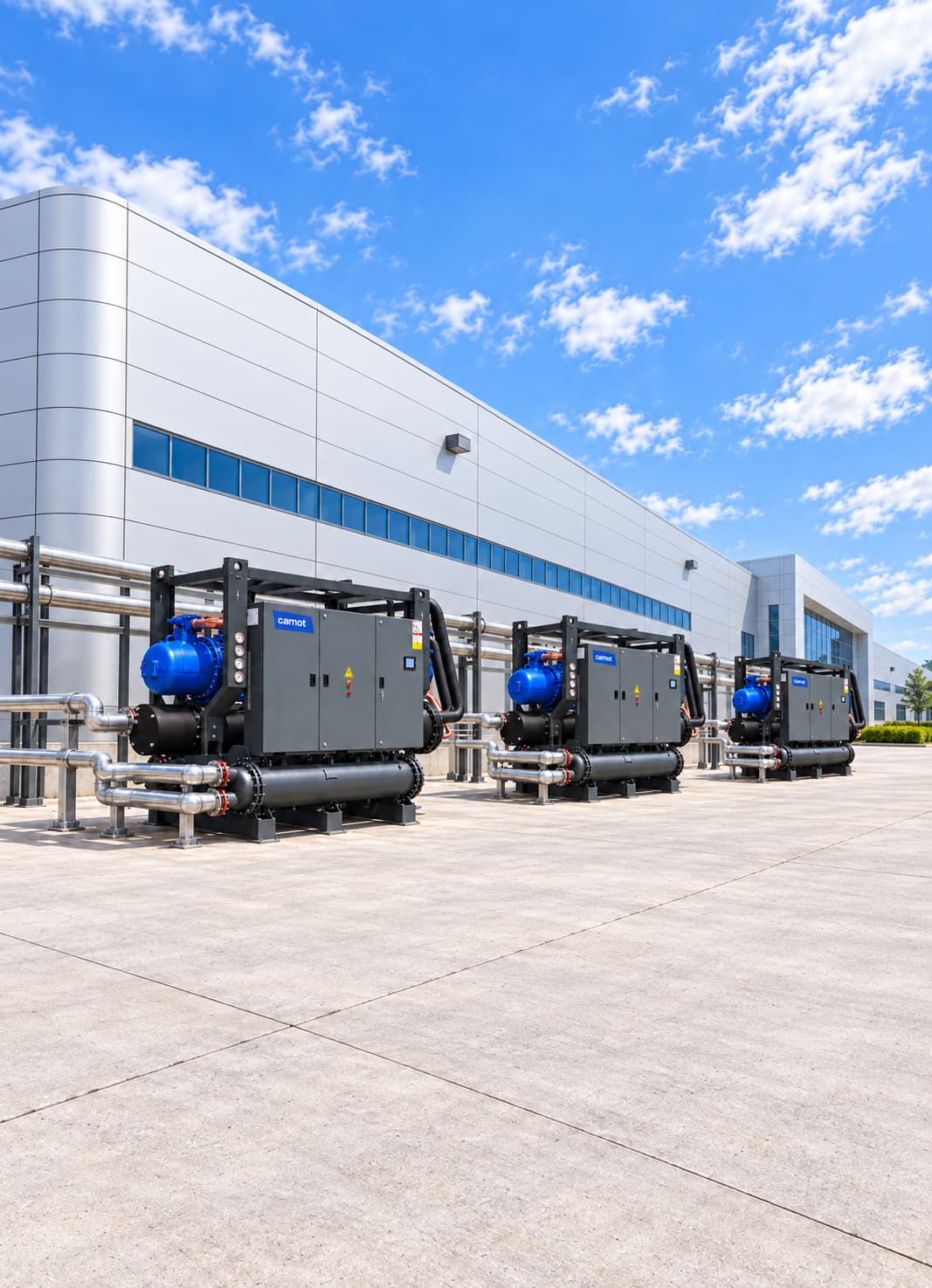

Water-Cooled Chiller Units
Water-cooled chiller units use the high heat-carrying capacity of water on the condenser side.
Tundra Series Chiller
A high-efficiency 30–4,000 kW water-cooled chiller range with scroll or screw compressor options.
- Capacity
- 30–4,000 kW
- Compressor
- Scroll / screw
Zero Series Chiller
A low-GWP, high-efficiency 10–4,000 kW water-cooled chiller range using R1234ze refrigerant.
- Capacity
- 10–4,000 kW
- Refrigerant
- R1234ze
What is a water-cooled chiller?
A water-cooled chiller removes heat from your process water and transfers it to a separate condenser water circuit instead of the outdoor air. That condenser water is then cooled by a cooling tower or, in a closed circuit, by a dry cooler. Because water carries heat far more effectively than air, the condenser runs at a lower, more stable temperature — which is why water-cooled units are the usual choice for large, continuous process loads.
Carnot's water-cooled range covers 10 to 4,000 kW across two series: Tundra with scroll or screw compressors and ZERO with low-GWP R1234ze refrigerant. Both are designed for plant-room installation, where there are no condenser fans on the unit and acoustic requirements are easier to meet.
Water-cooled vs air-cooled chillers
The right heat rejection method depends on the site rather than on the chiller alone. The table below summarises the main differences; for the air-cooled range see Air-Cooled Chiller Units.
| Criterion | Water-cooled chiller | Air-cooled chiller |
|---|---|---|
| Heat rejection | Condenser water circuit to a cooling tower or dry cooler | Condenser fans reject heat directly to outdoor air |
| Installation | Indoor plant room | Outdoors, at ground level or on the roof |
| Water use | Open cooling towers need make-up water; a closed dry-cooler circuit avoids evaporation | No condenser water circuit |
| Noise at the unit | No condenser fans on the chiller | Condenser fans run outdoors |
| Best suited to | Large, continuous loads and sites with an existing cooling-water circuit | Sites without plant-room space or a cooling-water circuit |
Tundra vs ZERO series
Both series cover large process loads; the choice usually comes down to refrigerant strategy and compressor technology.
| Series | Capacity | Refrigerant | Key features |
|---|---|---|---|
| Tundra | 30–4,000 kW | R407C | Scroll or screw compressors; plant-room installation without condenser fans on the unit |
| ZERO water-cooled | 10–4,000 kW | R1234ze (GWP 1.37) | Pump modulation and intelligent control; low-noise indoor use |
Centrifugal compressor options for the upper end of the range are in development.
How to size a water-cooled chiller
Sizing starts from the process, not from a catalogue capacity. We establish:
- Process heat load: measured or calculated from flow rate and temperature difference, including peaks.
- Supply and return water temperatures that the process actually needs.
- Condenser-side conditions: the cooling tower or dry cooler design temperatures for your site.
- Redundancy: whether an N+1 configuration is needed to keep production running during maintenance.
Our engineering team carries out this analysis as part of Design and Commissioning; regular chiller service and maintenance keeps the system at its design efficiency.
Frequently asked questions
Let's engineer solutions tailored to your needs
By analyzing your process and operational data against engineering criteria, we determine capacity, system configuration, and implementation details. Let's turn your technical requirements into the right equipment selection and an actionable system design.