Dry Cooler and Free Cooling Units
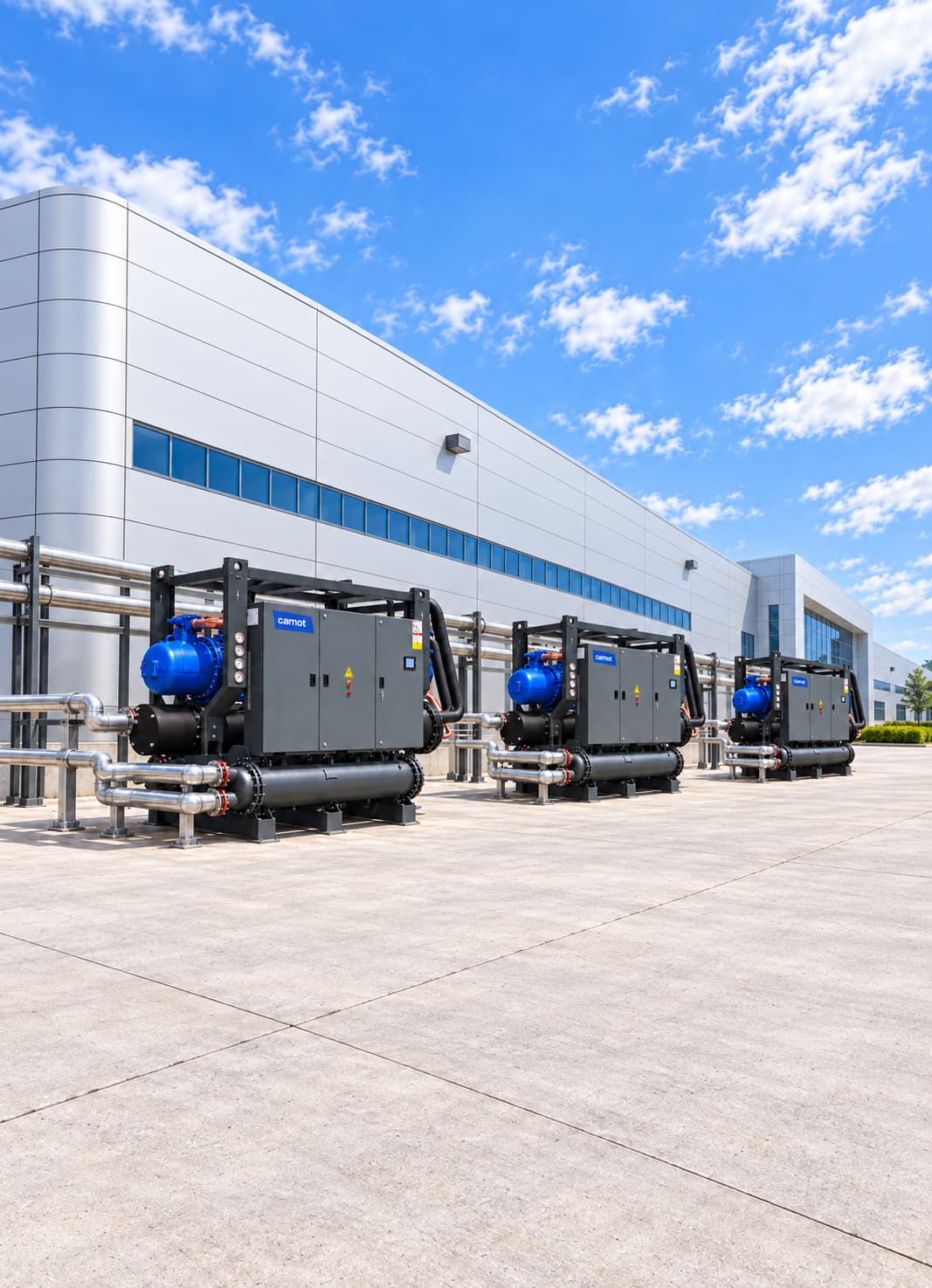
The dry cooler and free cooling range includes the Fusion free-cooling chiller and Kalter dry-cooler series.
Fusion Series
A 15–2,000 kW industrial chiller with mechanical, hybrid and full free-cooling modes for high annual energy savings.
- Capacity
- 15–2,000 kW
- Operating principle
- Free cooling
Kalter Series
A 90–1,800 kW industrial dry-cooler range with inverter fans, closed-circuit operation and low energy consumption.
- Capacity
- 90–1,800 kW
- System
- Dry cooler
How free cooling works
Free cooling uses cold outdoor air to cool process water instead of running compressors. Whenever the ambient temperature is below the return-water temperature, part of the heat can be rejected without mechanical cooling; when it is cold enough, the compressors switch off completely.
A free cooling chiller such as Fusion switches automatically between three modes:
- Mechanical: in warm weather the compressors provide all of the cooling.
- Hybrid: in the transitional seasons the free-cooling coil pre-cools the return water and the compressors cover the rest.
- Full free cooling: in cold weather the fans alone meet the load and the compressors stop.
Free cooling hours and energy savings
Savings depend on how many hours a year the outdoor temperature stays below the required water temperature. Processes that run around the clock with relatively warm water gain the most, because they can use free cooling for a large part of the year.
In Carnot's worked scenarios, Fusion achieves annual energy savings of up to 60%. The actual figure depends on the site's climate, water temperatures and load profile, so we calculate it for each project.
Fusion free cooling unit vs Kalter dry cooler
Both series use outdoor air without consuming water, but they do different jobs:
| Feature | Fusion | Kalter |
|---|---|---|
| What it is | Chiller with integrated free cooling | Dry cooler (closed-circuit fluid cooler) |
| Capacity | 15–2,000 kW | 90–1,800 kW |
| Operating modes | Mechanical, hybrid and full free cooling with automatic changeover | Heat rejection to air without compressors |
| Cools below ambient? | Yes, in mechanical mode | No — leaving water stays above the outdoor temperature |
| Typical use | Year-round process cooling, data centres | Condenser water for water-cooled chillers, process circuits that tolerate warmer water |
Dry cooler sizing: approach temperature and glycol
A dry cooler can only cool the fluid to a few degrees above the outdoor dry-bulb temperature. This difference — the approach — is the key sizing parameter: a smaller approach needs a larger heat exchanger and more airflow. Sizing therefore starts from the site's hottest design day and the warmest leaving-water temperature the process can accept.
Outdoor circuits usually run with glycol to prevent freezing in winter. Glycol reduces heat transfer and increases pumping power, so its concentration is chosen for the site's minimum temperature and included in the selection. Kalter's all-aluminium microchannel exchanger and load-based EC fans keep fan energy low when full capacity is not needed.
Frequently asked questions
Let's engineer solutions tailored to your needs
By analyzing your process and operational data against engineering criteria, we determine capacity, system configuration, and implementation details. Let's turn your technical requirements into the right equipment selection and an actionable system design.