

Carnot Technology: Centrifugal Chiller R&D, Oil-Free Magnetic Bearing Compressors and Defence Industry Cooling Solutions
Carnot's product development and research unit: continuous development of existing series, magnetic bearing centrifugal chiller R&D and project-based cooling solutions for the defence industry.
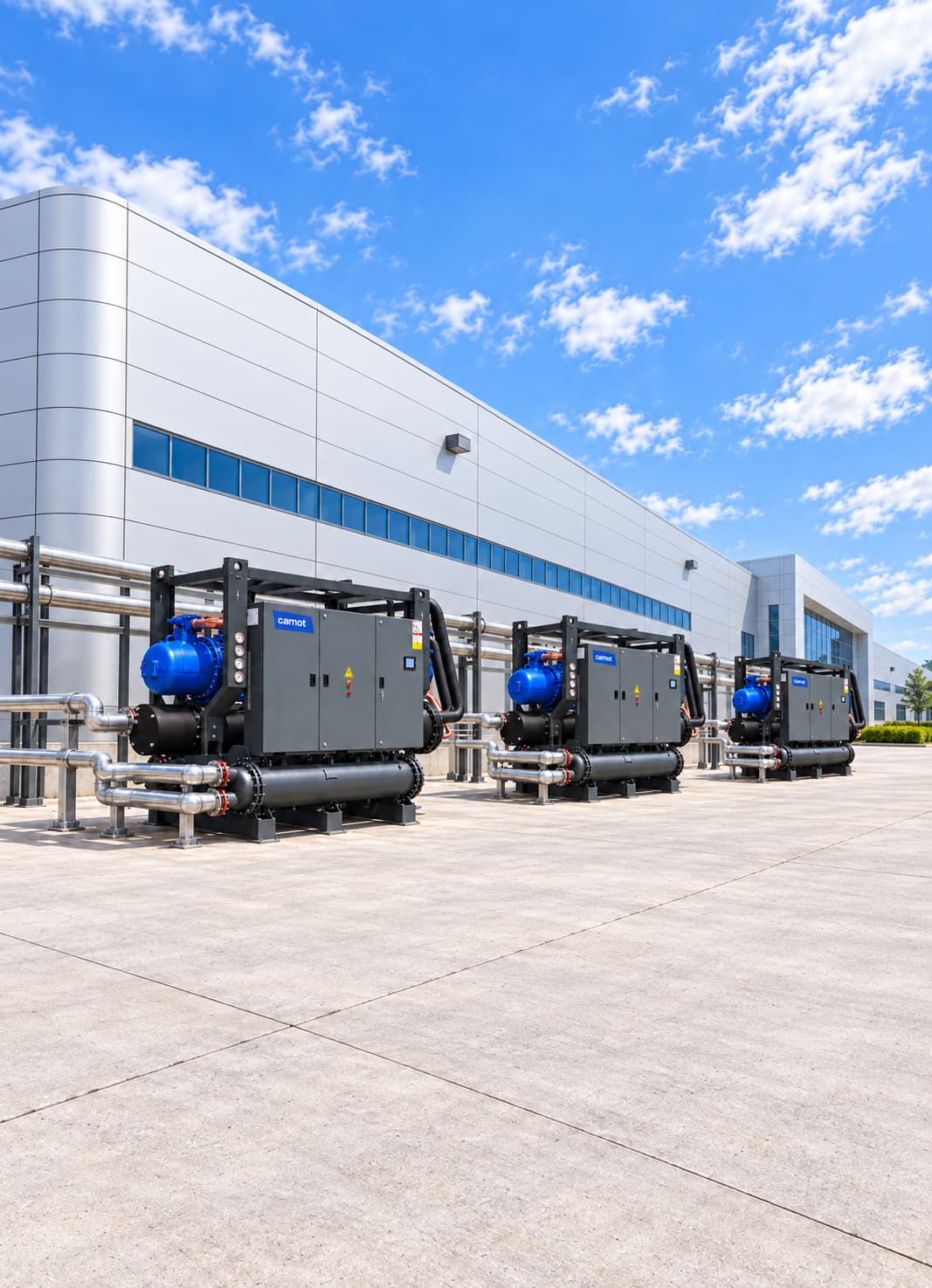
Carnot Technology is Carnot's product development and research unit. It works in three areas: continuous development of the Thule, Tundra, ZERO, Fusion, Kalter and Molder series using field data (product development); research and development projects in which new and patented products are designed (R&D) — today focused mainly on an oil-free magnetic bearing turbo compressor centrifugal chiller in the 800–4,500 kW range; and custom cooling solutions for the Turkish defence industry, delivered as projects from requirements to testing. All work is carried out under the same roof as the production facility and test infrastructure in Çayırova/Kocaeli; every product developed is handed directly to the production line and to the 25-person field service team.
What Does Carnot Technology Do?
A chiller manufacturer's technology unit answers two questions: how can the units running in the field today become more efficient, more reliable and easier to service; and which products will be needed tomorrow. Carnot Technology handles both questions within the same team, because fault, energy and usage data from the field is both the development input for existing products and the design input for new ones.
The unit covers mechanical design, refrigeration circuit design, electrical and automation engineering, and control software. Because it sits on the same site as the production facility, the move from prototype to series production does not wait on a separate supplier or plant. About Us Group Structure
Product Development: Continuous Improvement of Existing Series
Product development work draws on a database built from more than 12,000 machines in the field. The fault codes, operating parameters and component lifetimes that the service team records at every call-out are analysed regularly, and recurring findings are turned into design changes. This loop runs across the following areas:
Control software and automation. Compressor staging, fan speed control, electronic expansion valve (EEV) strategy, freeze protection and fault diagnosis logic are updated based on field data. The data points passed to the building management system (BMS) over Modbus RTU/TCP and BACnet are extended in line with customer requests. Chiller Retrofit and System Modernisation
Energy efficiency. Improvements such as part-load performance, inverter-driven EC fans, the move to microchannel condensers and free cooling integration are first trialled on an existing series and then made standard. The ZERO series' move to R1234ze and the Fusion series' free cooling control algorithm are outputs of this process. ZERO Fusion
Serviceability. Component access, maintenance intervals, spare part standardisation and model-specific maintenance kits are built into the design based on feedback from field technicians. The aim is to shorten planned maintenance time and unplanned downtime. Chiller Planned Maintenance Agreements
Refrigerant transition. Under the F-Gas Regulation (EU 2024/573), the move from high-GWP refrigerants to low-GWP alternatives such as R1234ze, R513A and R290 is carried out on existing series together with circuit design, oil compatibility and safety class (A2L/A3) requirements. Chemic
R&D: Magnetic Bearing Centrifugal Chiller Project
Carnot Technology's current R&D focus is a water-cooled centrifugal chiller using an oil-free magnetic bearing turbo compressor. Above the capacity band where scroll and screw compressors are efficient — large data centres, campus-type sites, power plants and large process lines — centrifugal technology offers lower part-load consumption, fewer moving parts and a lower refrigerant charge. Because this segment is largely served by imported products in Turkey, the project aims to close that gap with domestic design and manufacturing.
Technical framework of the project:
| Compressor technology | Magnetic bearing, oil-free, variable-speed turbo (centrifugal) compressor |
|---|---|
| Capacity range | 800–4,500 kW; single and multi-compressor configurations |
| Refrigerant | R1234ze (HFO, GWP < 1, A2L) |
| Condenser type | Water-cooled; optional dry cooler and free cooling integration |
| Control | Stepless capacity control, integrated inverter drive, surge protection, Modbus/BACnet communication |
| Project stage | Design and engineering |
| Design and test standards | EN 14511 (capacity and efficiency rating), EN 378 (safety) |
Because the rotor runs without contact in a magnetic bearing compressor, there is no oil circuit, oil separator or oil cooler; the evaporator heat transfer surface is not fouled by oil, and maintenance items caused by mechanical wear disappear. Capacity is adjusted steplessly using variable speed and inlet guide vanes (IGV); in the part-load region where a chiller spends most of the year, this makes a clear consumption difference compared with fixed-speed screw systems. The control software developed in the project covers surge protection, bearing control system monitoring, stable operation at low load and balancing between multiple compressors.
Once design validation is complete, the prototype will be built at the Çayırova facility and tested on the test rig under EN 14511 conditions; the validated design will form the upper capacity band of the Tundra and ZERO water-cooled families. Tundra ZERO Water-Cooled Data Centre Cooling Systems
Project-Based Cooling Solutions for the Defence Industry
For requirements that fall outside the standard product catalogue, Carnot Technology develops project-based cooling systems for Turkish defence industry organisations. In these projects the customer does not buy a series product but a cooling solution designed, tested and documented against a specific requirements document. Customer and project information is confidential; only application classes and design criteria are given below.
Application classes
- Electronics cooling for radar, electronic warfare and communication systems — stable inlet temperature, low temperature fluctuation, redundant circuit
- High-precision process cooling for directed-energy and laser systems — circuit and control structure derived from the Thule laser configuration Thule
- Environmental conditioning for test and qualification facilities — wide temperature range, glycol circuit, low-temperature configuration down to −45 °C
- Compact or containerised cooling units for land, naval and fixed platforms — transportability, vibration resistance, limited space
- Process cooling in defence industry production plants — composites, machining, surface treatment and casting lines Automotive and Metalworking
Design criteria
- Design to the requirements document (technical specification); every criterion verified by a test report
- Component selection and cabinet construction for harsh conditions such as high ambient temperature, dust, salt atmosphere and vibration
- Design and test planning according to the environmental test requirements defined in the specification
- Domestic design and manufacturing; spare part and service continuity for critical components
- Control architecture meeting redundancy (N+1), remote monitoring and secure communication requirements
- Site installation, commissioning and maintenance after delivery, carried out on site by the Carnot service team Design and Commissioning
Project process
- Requirements analysis and technical specification review
- Conceptual design and capacity/heat balance calculation
- Detailed design: refrigeration circuit, hydraulics, electrical and automation, cabinet
- Prototype manufacturing and factory acceptance tests (FAT)
- Site installation, commissioning and site acceptance tests (SAT)
- Documentation: test reports, IOM manual, spare parts list, maintenance plan
Test and Validation Infrastructure
Every product and project-based system developed goes through capacity, electrical, leak-tightness, vacuum and function tests in the test area at the Çayırova facility. Capacity tests are performed at EN 14511 rating conditions; for project-based systems, additional test conditions from the customer's specification (ambient temperature, part load, emergency stop scenarios) are added to the test plan. Test data is fed back into the product development loop.
Technical Questions About Carnot Technology
Prepared by: Carnot Technology · Last updated:
Let's Assess Your Technical Requirement Together
If you have an off-catalogue cooling requirement, a technical specification or a question about the centrifugal chiller project, talk directly to the Carnot Technology team.