
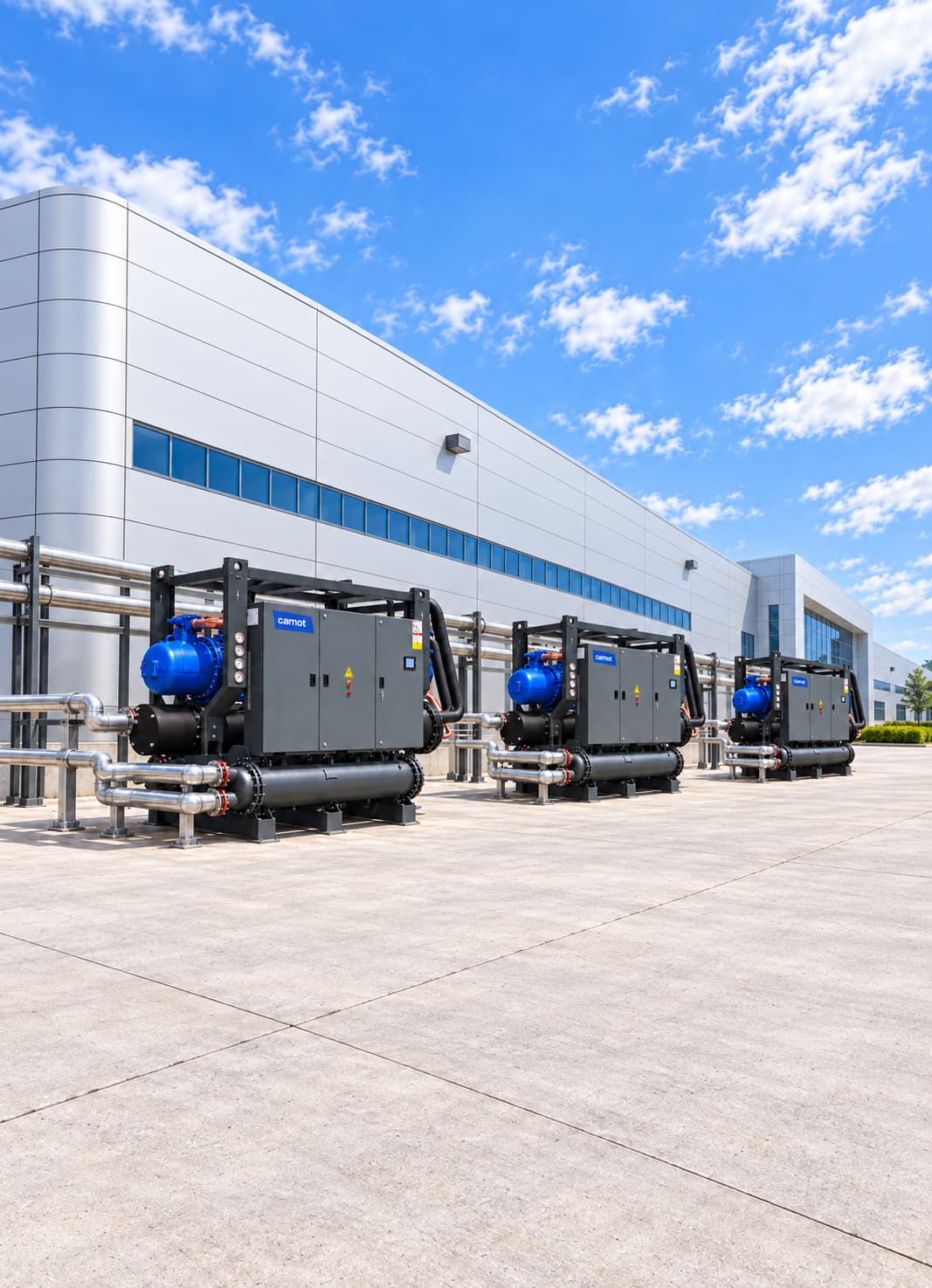


Process Cooling Systems for the Food and Beverage Industry
A food and beverage process cooling system combines chillers, dry coolers and controls to supply post-pasteurisation cooling, fermentation, filling and freezing processes with chilled water (0.5–2 °C), process water or food-grade glycol. A hygienic heat exchanger separates the utility circuit from the product. Carnot designs each system for the facility, from product-load calculations to HACCP-compatible fluid selection.
Sector Overview & Process Demands
A food and beverage process cooling system combines chillers, dry coolers and controls to supply post-pasteurisation cooling, fermentation, filling and freezing processes with chilled water (0.5–2 °C), process water or food-grade glycol. A hygienic heat exchanger separates the utility circuit from the product. Carnot designs each system for the facility, from product-load calculations to HACCP-compatible fluid selection.
Cooling is central to product safety, process stability, shelf life and production capacity in food and beverage manufacturing. If product temperature cannot be reduced within the required time, microbiological risk can rise, quality can fall, process time can increase and the production line can slow down.
Carnot develops central and process-level cooling systems for dairy, beverages, brewing, ice cream, meat processing, bakery production and other food processes. Chillers, dry coolers, free cooling, pump and tank groups and controls maintain the required water temperature, flow rate and cooling capacity as production loads change.
Critical Operational Requirements
Why Is Process Cooling Important in Food Production?
Food plants need controlled heat transfer at many stages, not only lower room-air temperature. It is needed from raw-material intake through mixing and cooking to rapid product cooling, filling and storage. A properly engineered process cooling system supports these steps.
- Reduces product temperature in the targeted time.
- Keeps production recipes repeatable.
- Keeps heat exchangers operating at stable temperatures.
- Protects product quality and shelf life.
- Reduces waiting times in the production line.
- Prevents capacity loss during intensive production periods.
- Provides seamless cooling in critical processes.
- Keeps energy and water consumption under control.
Which Food and Beverage Processes Are Served?
Typical process temperatures include raw-milk storage at 4 °C (the Turkish Food Codex calls for cooling below 6 °C within two hours after milking), post-pasteurisation cooling to 4 °C, beer fermentation at 8–14 °C and cold conditioning at −1 to 0 °C, beverage carbonation at 2–4 °C, chocolate tempering at 27–32 °C, ice-cream freezer discharge at −5 °C and hardening at −30 to −40 °C, and carcass chilling below 7 °C within 24 hours. Each process differs in product temperature, timing, fluid and hygiene requirements. Size the plant from the heat removed at each stage, not total production volume alone.
- Raw milk cooling and milk products production
- Yogurt, ayran and cheese processes
- Ice-cream production and hardening lines
- Fruit juice and carbonated-beverage production
- Bottling and filling lines
- Beer, wine and fermentation processes
- Meat, poultry and fish processing plants
- Chocolate and confectionery production
- Bakery and flour-based food production
- Vegetable-oil production
- Sauce, tomato-paste and canned-food production
- After cooking product cooling
- Chilled-water and glycol circuits
- Line and tank cooling after CIP
- Cold room and auxiliary cooling systems
System Design & Capacity Calculation
Engineering & Sizing Criteria
How Is a Food Process Cooling System Designed?
Assess product properties, production schedule and critical process temperatures together. In addition to the product load, include tanks, heat exchangers, pumps, pipework, ambient heat gains, CIP cycles and auxiliary equipment.
| Design Parameter | Engineering Significance |
|---|---|
Product inlet and outlet temperature | Determines the heat to be removed from the product. |
Hourly production capacity | Determines instantaneous and total cooling load. |
Specific heat of the product | Changes the cooling load of different products in the same quantity. |
Cooling time | Determines the required instant chiller capacity directly. |
Freezing or phase change | Requires a latent-heat calculation in addition to sensible heat. |
Daily load profile | Guides how capacity is divided between ice storage and the chiller. |
Process fluid temperature | Determines chiller operating conditions and energy efficiency. |
CIP program | Affects post-CIP cooling peaks and capacity planning. |
Flow and pressure loss | Determines pump selection and exchanger performance. |
Minimum and maximum load | Determines compressor stepping and partial load efficiency. |
Redundancy requirement | Maintains cooling on critical production lines. |
Hygiene and fluid separation | Keeps the product circuit safely separate from the utility cooling circuit. |
Capacity Calculation & Thermodynamic Formula
How Is Product Cooling Capacity Calculated?
The capacity needed to cool a product from its initial temperature to the target temperature is calculated using the following basic equation:
Q = m × cp × ΔT
Worked Engineering Example
Here Q is heat to be removed, m is product mass, cp is product specific heat and ΔT is the inlet-to-outlet temperature difference. Divide total energy by the allowed cooling time to find instantaneous capacity. For example, cooling 5,000 litres of milk per hour from 35 °C to 4 °C gives Q = 5,000 × 3.9 × 31 ÷ 3,600 ≈ 168 kW. For the water loop, Q (kW) = 1.163 × Flow (m³/h) × ΔT (°C); at 80 m³/h and 4 °C, Q = 1.163 × 80 × 4 = 372.16 kW. Freezing also requires latent heat for the water in the product (334 kJ/kg). In ice cream with 60–70% water, that latent load can be several times the sensible load per unit mass. Account for product composition, freezing point and required process time. Typical food-product specific heat values are listed in the table below.
The theoretical heat load carried by this water circuit is approximately 372 kW. Final chiller selection also includes heat gains from tanks and pipework, simultaneous processes, cleaning cycles and load changes.
Sector Reference Data
Product Specific Heat Values
| Product | Specific heat (kJ/kg·K) |
|---|---|
| Water (reference) | 4.186 |
| Fruit juice, beer, soft drinks | 3.8–4.0 |
| Milk | 3.9 |
| Yogurt, Ayran | 3.7 |
| Meat, poultry (unfrozen) | 2.9–3.2 |
| Vegetable oil | 2.0 |
| Chocolate | 1.6 |
Energy Optimization
Share your production schedule to compare direct chilled-water supply with an ice-bank arrangement.
Energy Consumption & Annual Operating Cost Analysis
750 kW Dairy & Beverage Plant Annual Energy Simulation
Theoretical full-load comparison for an example food processing plant with 750 kW cooling demand operating 6,000 hours/year.
Scenario comparison table
| System | COP | Compressor power | Annual consumption |
|---|---|---|---|
| Reference chiller system | 4.50 | 166.7 kW | 1,000,200 kWh |
| High-efficiency Carnot system | 5.75 | 130.4 kW | 782,400 kWh |
| Theoretical saving / difference | — | 36.3 kW | 217,800 kWh (21.7%) |
| Annual cost advantage | — | €0.12/kWh | Approximately €26,100 |
Annual Electricity Savings
217,800 kWh
21.7% theoretical reduction in compressor use
Annual Cost Advantage
~26,100 €
Calculated at €0.12/kWh reference electricity rate
Theoretical Power Difference
36.3 kW
Reference COP 4.50 / Carnot COP 5.75
Note: This calculation compares compressor power at 6,000 hours of full load. Actual annual savings will depend on plant load profiles, process temperatures, pump and fan modulation, local weather data, and economizer hours.
Engineering & Sizing Checklist
Let’s Design the Cooling System for Your Food Process
Carnot engineers the full system for your process, from product-load calculations and chiller, exchanger and hydraulic-equipment selection to integration with an existing ice bank, controls and annual energy analysis. The information below is enough for an initial review:
- 1Product and process type
- 2Hourly production volume and daily schedule
- 3Product inlet and target outlet temperatures
- 4Required cooling time
- 5Process water, ice water or glycol temperatures
- 6Flow and pressure need
- 7CIP program and frequency
- 8Daily and annual working time
- 9Electricity tariff (day/night)
- 10Facility location
- 11Current cooling system and ice bank information
- 12Critical processes and redundancy needs
Request Process Cooling Design
Share your facility specs, and our engineering team will prepare your energy and capacity simulation.
Related products
Thule Series Air-Cooled Chiller
Supplies water or glycol for food processes without a cooling tower.
- Capacity
- 2–2,000 kW
- Compressor
- Scroll / screw
Tundra Series Water-Cooled Chiller
Suited to high-capacity production lines with long operating hours.
- Capacity
- 30–4,000 kW
- Compressor
- Scroll / screw
ZERO Series Chiller
A low-GWP refrigerant option for food and beverage facilities.
- Capacity
- 10–1,800 kW
- Refrigerant
- R1234ze
Fusion Series Free Cooling Unit
Reduces compressor operating hours when outdoor conditions allow.
- Capacity
- 15–2,000 kW
- Operating principle
- Free cooling
Kalter Series Dry Cooler
Removes heat from CIP cooling and auxiliary process circuits.
- Capacity
- 90–1,800 kW
- System
- Dry cooler
Technical Questions About Food & Beverage Cooling Systems
Detailed engineering answers on system sizing, capacity calculations, water temperatures, and Carnot equipment.
Let's engineer solutions tailored to your needs
By analyzing your process and operational data against engineering criteria, we determine capacity, system configuration, and implementation details. Let's turn your technical requirements into the right equipment selection and an actionable system design.